
Deployment Patterns
Choose between Arc Enterprise's two cluster topologies — shared object storage or local disks with peer replication — and what each implies for durability, cost, and operations.
Arc Enterprise supports two clustering topologies, each optimized for a different operational environment. The choice is about where the Parquet files live — and that decision shapes durability, cost, and the operational model of your cluster.
The two patterns
Pattern A: Shared object storage
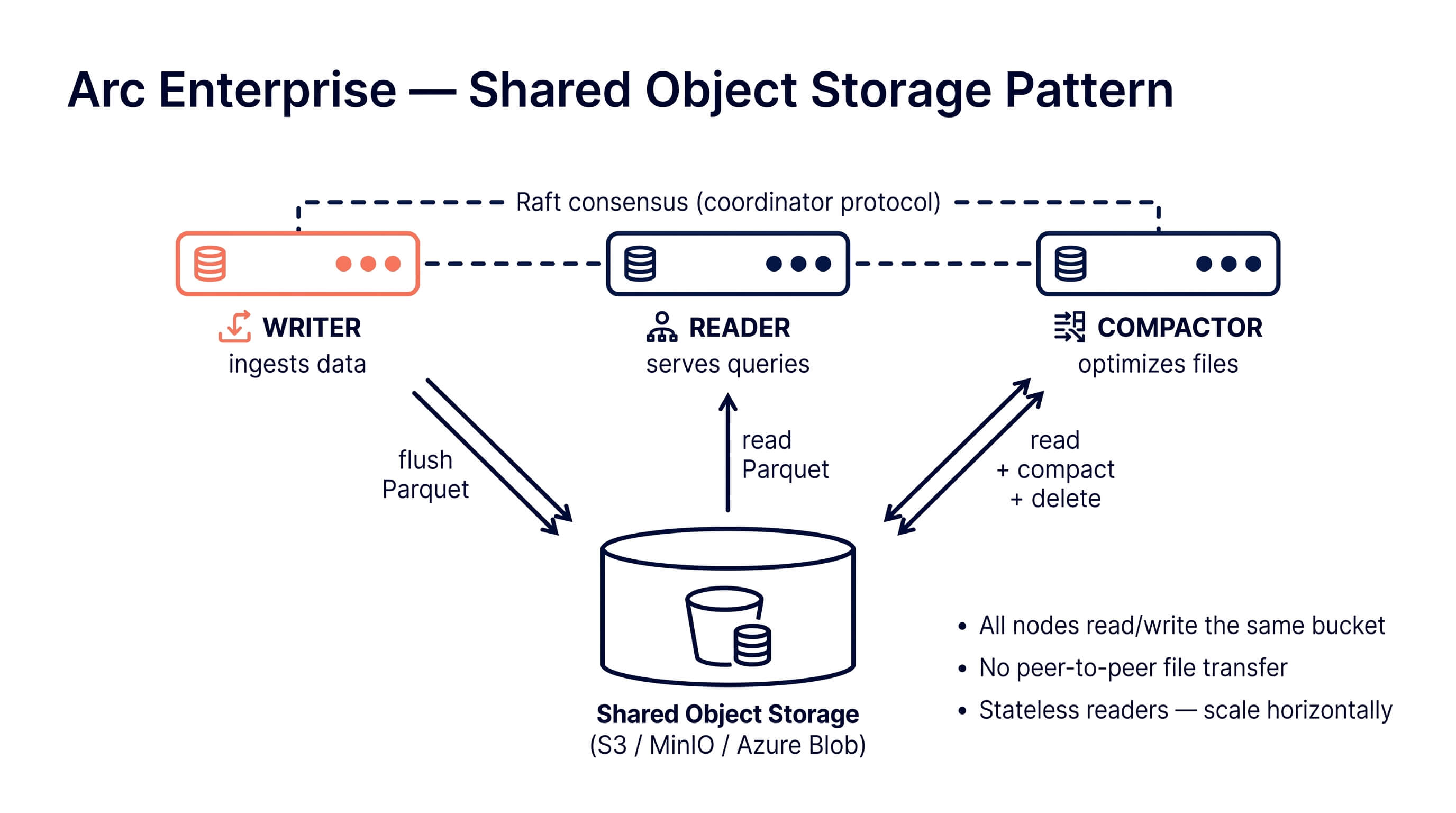
All nodes read and write to the same object store — S3, MinIO, or Azure Blob. The bucket is the source of truth for Parquet files. Nodes are stateless from a data perspective: any reader can serve any query because every file is one API call away.
Best for:
- Cloud deployments (AWS, GCP, Azure)
- Teams that already operate object storage
- Workloads where scaling readers elastically matters more than query latency
- Kubernetes-native deployments with object storage
Pattern B: Local storage with peer replication
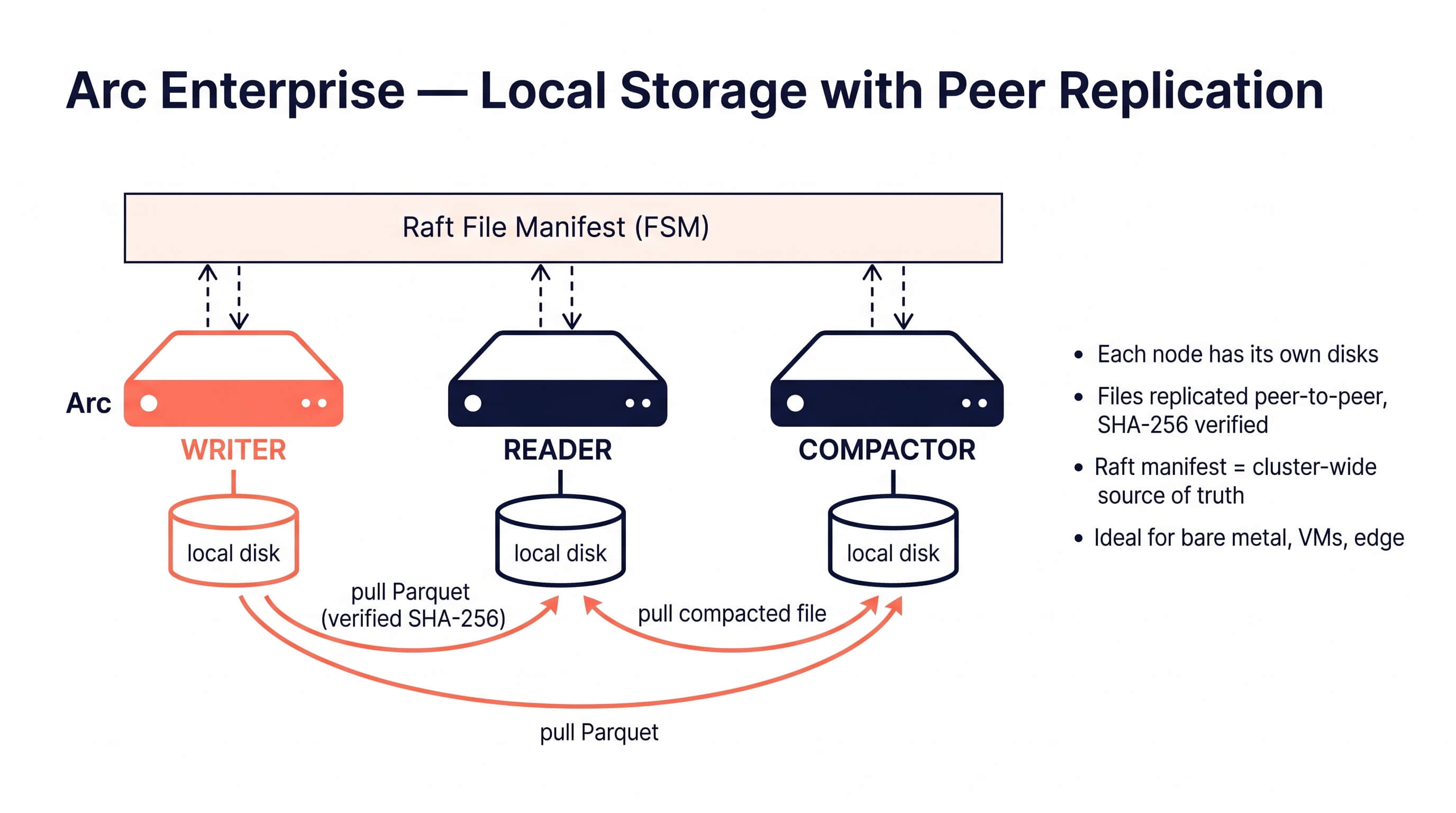
Each node has its own local disks (NVMe, SSD, or attached block storage). Parquet files are replicated peer-to-peer over the cluster protocol, verified via SHA-256, and kept on every node that needs them. A Raft-backed file manifest is the cluster-wide source of truth for which files exist.
Best for:
- Bare metal and virtual machine deployments
- Edge, on-premises, and air-gapped environments
- Defense, aerospace, industrial, and regulated workloads where shared object storage is not available
- Deployments that need the lowest possible query latency (local NVMe beats network-attached storage every time)
Side-by-side comparison
| Aspect | Shared Object Storage | Local Storage + Peer Replication |
|---|---|---|
| Storage layout | Single bucket, all nodes read/write | Per-node local disks, replicated peer-to-peer |
| Source of truth | The bucket itself | Raft-backed file manifest (FSM) |
| Durability | Relies on S3/MinIO/Azure replication | Replicated across N cluster nodes |
| Query latency | Network fetch from object store | Local disk I/O |
| New-node bootstrap | Instant (no data transfer needed) | Startup catch-up pulls bytes from peers |
| Compactor outputs | Written once to bucket, visible to all | Compactor writes locally, Raft announces, peers pull |
| Compactor failover | Any healthy node can take over | Any healthy node can take over |
| Writer HA | All writers take traffic; losing one is routed around | One writer takes ingest; a standby writer is promoted |
| Nodes needed for HA | Three writer-role nodes | Three writer-role nodes |
| Best deployment | Kubernetes, cloud-native | Bare metal, VMs, edge |
| Cost model | Object storage API calls + egress | Local disk capacity × nodes |
| Network requirements | Reliable path to object store | Reliable path between cluster nodes |
How many writers
Both patterns need three writer-role nodes to be highly available, for the same reason: writer-role nodes are the entire redundancy pool. Readers replicate the WAL and serve queries, but they are never promoted, so they do not substitute for writers.
One writer is a development shape. Two absorbs exactly one failure and then leaves you with a single writer, no spare, and no pod you can drain for a rolling upgrade; the Helm chart refuses that count outright. Arc itself logs a rate-limited warning while a cluster is running below three writer-role nodes, in both patterns.
Raft quorum follows the same count, because only nodes that accept writes vote.
Writers and any node left at the default standalone role are the voters;
readers and compactors replicate the log and see all cluster state but never
campaign. So three writers tolerate one loss on both counts at once, ingest and
Raft, and two writers means two voters, where losing one leaves no leader and
cluster-wide state changes stop until it returns. Adding readers does not help.
Two caveats. A cluster upgraded in place keeps any node that did not shut down gracefully as a voter until it is removed and re-joins, so the voter set converges over a rolling restart rather than at the moment of upgrade. And if you run nodes at the default role alongside writers, they vote too, so count them.
What the three writers do differs by pattern. On shared storage all three take ingest simultaneously behind a load balancer. On local storage one is elected primary and takes ingest while the other two replicate and stand by, because the data is not shared and a second active writer would hold rows no other node can see.
Choosing a pattern
Start here:
- Do you already run S3/MinIO/Azure in production? → Pattern A (shared).
- Do your nodes have fast local disks and you want minimum query latency? → Pattern B (local).
- Is shared object storage unavailable (edge, air-gap, defense)? → Pattern B (local).
- Do you expect to scale readers elastically based on demand? → Pattern A (shared).
- Do you need a single-digit-ms query path? → Pattern B (local).
You can also mix — a cluster can use shared object storage for cold data (tiered storage to S3 or Azure Blob Storage) while keeping hot data on local disks. See Tiered Storage.
Pattern A — shared storage setup
Minimal 3-node cluster (1 writer, 1 reader, 1 compactor) on MinIO
# docker-compose.yml
services:
  minio:
    image: minio/minio
    command: server /data --console-address ":9001"
    environment:
      MINIO_ROOT_USER: minioadmin
      MINIO_ROOT_PASSWORD: minioadmin123
    ports: ["9001:9001"]

  arc-writer:
    image: basekick/arc:latest
    environment:
      ARC_LICENSE_KEY: "ARC-XXXX-XXXX-XXXX-XXXX"
      ARC_STORAGE_BACKEND: minio
      ARC_STORAGE_S3_BUCKET: arc-data
      ARC_STORAGE_S3_ENDPOINT: minio:9000
      ARC_STORAGE_S3_ACCESS_KEY: minioadmin
      ARC_STORAGE_S3_SECRET_KEY: minioadmin123
      ARC_STORAGE_S3_USE_SSL: "false"
      ARC_STORAGE_S3_PATH_STYLE: "true"
      ARC_CLUSTER_ENABLED: "true"
      ARC_CLUSTER_NODE_ID: writer-01
      ARC_CLUSTER_ROLE: writer
      ARC_CLUSTER_CLUSTER_NAME: production
      ARC_CLUSTER_RAFT_BOOTSTRAP: "true"
      ARC_CLUSTER_SHARED_SECRET: "your-cluster-secret"
      ARC_CLUSTER_REPLICATION_ENABLED: "false"  # not needed on shared storage
    ports: ["8001:8000"]

  arc-reader:
    image: basekick/arc:latest
    environment:
      ARC_LICENSE_KEY: "ARC-XXXX-XXXX-XXXX-XXXX"
      ARC_STORAGE_BACKEND: minio
      ARC_STORAGE_S3_BUCKET: arc-data
      ARC_STORAGE_S3_ENDPOINT: minio:9000
      ARC_STORAGE_S3_ACCESS_KEY: minioadmin
      ARC_STORAGE_S3_SECRET_KEY: minioadmin123
      ARC_STORAGE_S3_USE_SSL: "false"
      ARC_STORAGE_S3_PATH_STYLE: "true"
      ARC_CLUSTER_ENABLED: "true"
      ARC_CLUSTER_NODE_ID: reader-01
      ARC_CLUSTER_ROLE: reader
      ARC_CLUSTER_CLUSTER_NAME: production
      ARC_CLUSTER_SEEDS: arc-writer:9200
      ARC_CLUSTER_SHARED_SECRET: "your-cluster-secret"
    ports: ["8002:8000"]

  arc-compactor:
    image: basekick/arc:latest
    environment:
      ARC_LICENSE_KEY: "ARC-XXXX-XXXX-XXXX-XXXX"
      ARC_STORAGE_BACKEND: minio
      ARC_STORAGE_S3_BUCKET: arc-data
      ARC_STORAGE_S3_ENDPOINT: minio:9000
      ARC_STORAGE_S3_ACCESS_KEY: minioadmin
      ARC_STORAGE_S3_SECRET_KEY: minioadmin123
      ARC_STORAGE_S3_USE_SSL: "false"
      ARC_STORAGE_S3_PATH_STYLE: "true"
      ARC_CLUSTER_ENABLED: "true"
      ARC_CLUSTER_NODE_ID: compactor-01
      ARC_CLUSTER_ROLE: compactor
      ARC_CLUSTER_CLUSTER_NAME: production
      ARC_CLUSTER_SEEDS: arc-writer:9200
      ARC_CLUSTER_SHARED_SECRET: "your-cluster-secret"
      ARC_CLUSTER_FAILOVER_ENABLED: "true"
      ARC_COMPACTION_ENABLED: "true"
    ports: ["8003:8000"]
Key points
- All nodes point to the same bucket. The writer flushes to the bucket; readers query directly from it; the compactor reads source files, writes compacted outputs back, and deletes the sources.
ARC_CLUSTER_REPLICATION_ENABLED=falseis the right choice on shared storage — there's no peer-to-peer file transfer needed because the bucket is already shared.- Exactly one compactor node. Multiple compactors against a shared bucket produce duplicate outputs. Arc warns you via the cluster health check if it sees more than one.
- Compactor failover (
ARC_CLUSTER_FAILOVER_ENABLED=true) lets the Raft leader automatically reassign the compactor lease to another healthy node if the current compactor dies. No restart required.
Pattern B — local storage setup
Minimal 3-node cluster (1 writer, 1 reader, 1 compactor) on local disks
# docker-compose.yml
services:
  arc-writer:
    image: basekick/arc:latest
    environment:
      ARC_LICENSE_KEY: "ARC-XXXX-XXXX-XXXX-XXXX"
      ARC_STORAGE_BACKEND: local
      ARC_STORAGE_LOCAL_PATH: /app/data
      ARC_CLUSTER_ENABLED: "true"
      ARC_CLUSTER_NODE_ID: writer-01
      ARC_CLUSTER_ROLE: writer
      ARC_CLUSTER_CLUSTER_NAME: production
      ARC_CLUSTER_RAFT_BOOTSTRAP: "true"
      ARC_CLUSTER_SHARED_SECRET: "your-cluster-secret"
      ARC_CLUSTER_REPLICATION_ENABLED: "true"   # CRITICAL for local storage
    volumes:
      - writer-data:/app/data
    ports: ["8001:8000"]

  arc-reader:
    image: basekick/arc:latest
    environment:
      ARC_LICENSE_KEY: "ARC-XXXX-XXXX-XXXX-XXXX"
      ARC_STORAGE_BACKEND: local
      ARC_STORAGE_LOCAL_PATH: /app/data
      ARC_CLUSTER_ENABLED: "true"
      ARC_CLUSTER_NODE_ID: reader-01
      ARC_CLUSTER_ROLE: reader
      ARC_CLUSTER_CLUSTER_NAME: production
      ARC_CLUSTER_SEEDS: arc-writer:9200
      ARC_CLUSTER_SHARED_SECRET: "your-cluster-secret"
      ARC_CLUSTER_REPLICATION_ENABLED: "true"
    volumes:
      - reader-data:/app/data
    ports: ["8002:8000"]

  arc-compactor:
    image: basekick/arc:latest
    environment:
      ARC_LICENSE_KEY: "ARC-XXXX-XXXX-XXXX-XXXX"
      ARC_STORAGE_BACKEND: local
      ARC_STORAGE_LOCAL_PATH: /app/data
      ARC_CLUSTER_ENABLED: "true"
      ARC_CLUSTER_NODE_ID: compactor-01
      ARC_CLUSTER_ROLE: compactor
      ARC_CLUSTER_CLUSTER_NAME: production
      ARC_CLUSTER_SEEDS: arc-writer:9200
      ARC_CLUSTER_SHARED_SECRET: "your-cluster-secret"
      ARC_CLUSTER_REPLICATION_ENABLED: "true"
      ARC_CLUSTER_FAILOVER_ENABLED: "true"
      ARC_COMPACTION_ENABLED: "true"
    volumes:
      - compactor-data:/app/data
    ports: ["8003:8000"]

volumes:
  writer-data:
  reader-data:
  compactor-data:
How peer replication works
- Writer flushes a Parquet file locally. The file hash (SHA-256) is computed and included in the flush.
- The writer registers the file in the Raft manifest via a
CommandRegisterFileentry. This commits cluster-wide — every node now knows the file exists and where to find it. - Readers and compactors observe the FSM callback. A background puller enqueues a byte-level pull from the origin peer (or any healthy peer that has a copy).
- The puller fetches over the cluster protocol, streams bytes, verifies the SHA-256 against the manifest, and writes to local storage. Checksum mismatches trigger retries; failed pulls fall back to other peers.
- On node restart, a startup catch-up walker reconciles the local manifest against the Raft FSM and pulls any files the node missed.
Key points
ARC_CLUSTER_REPLICATION_ENABLED=trueis required — this enables the file manifest and peer puller.- Each node has its own volume. No shared volume, no NFS, no clustered filesystem — the replication is the primary data-plane mechanism.
- Shared secret is mandatory. Peer fetch requests are HMAC-authenticated with the shared secret; Arc refuses to start replication without one.
- Raft leader is the writer by default.
ARC_CLUSTER_RAFT_BOOTSTRAP=trueon the writer makes it bootstrap Raft; other nodes join via the seed. Non-leader nodes forward manifest commands to the leader transparently.
Compacted file distribution
Compaction on local storage works the same way as ingest:
- The compactor reads source Parquet files (from local storage, pulling from peers if missing).
- It produces a compacted output, writes it to its own local disk.
- It registers the new file in the Raft manifest and marks the source files as deleted.
- Every other node sees the manifest change: readers pull the compacted bytes from the compactor, and delete their local copies of the source files.
Security notes
Both patterns share the same security posture:
- Shared secret authentication (
cluster.shared_secret) — required for peer discovery and, in Pattern B, for all peer file fetches. Arc refuses to boot if replication is enabled without a shared secret. - TLS encryption (
cluster.tls_enabled) — optional but recommended. Encrypts the inter-node coordinator protocol, Raft transport, and peer file transfers. - Role-based authorization on manifest mutations — only nodes with
CanIngest(writers) orCanCompact(compactors) can forwardRegisterFile/DeleteFilecommands to the leader. Reader nodes are rejected.
See Cluster Security for full details.
Common mistakes
- Multiple compactor nodes on shared storage. This produces duplicate compacted outputs and double-counted query results. Use exactly one
ARC_CLUSTER_ROLE=compactorand enableARC_CLUSTER_FAILOVER_ENABLED=truefor automatic failover. - Mixing shared and local storage in the same cluster. All nodes must agree on the storage model. Pick one per cluster.
- Forgetting
ARC_CLUSTER_REPLICATION_ENABLED=trueon local storage. Without it, readers will query empty local directories. - Using a shared volume (NFS, EFS) as "local" storage. Don't — the concurrent-write semantics of a shared POSIX filesystem aren't what Arc expects, and you lose the durability guarantees of either pattern. Either go full shared object storage or full per-node local disks.
Next steps
- Clustering Configuration Reference — full list of cluster config options
- Tiered Storage — combine local hot storage with cold object storage
- Cluster Security — TLS and shared secret configuration